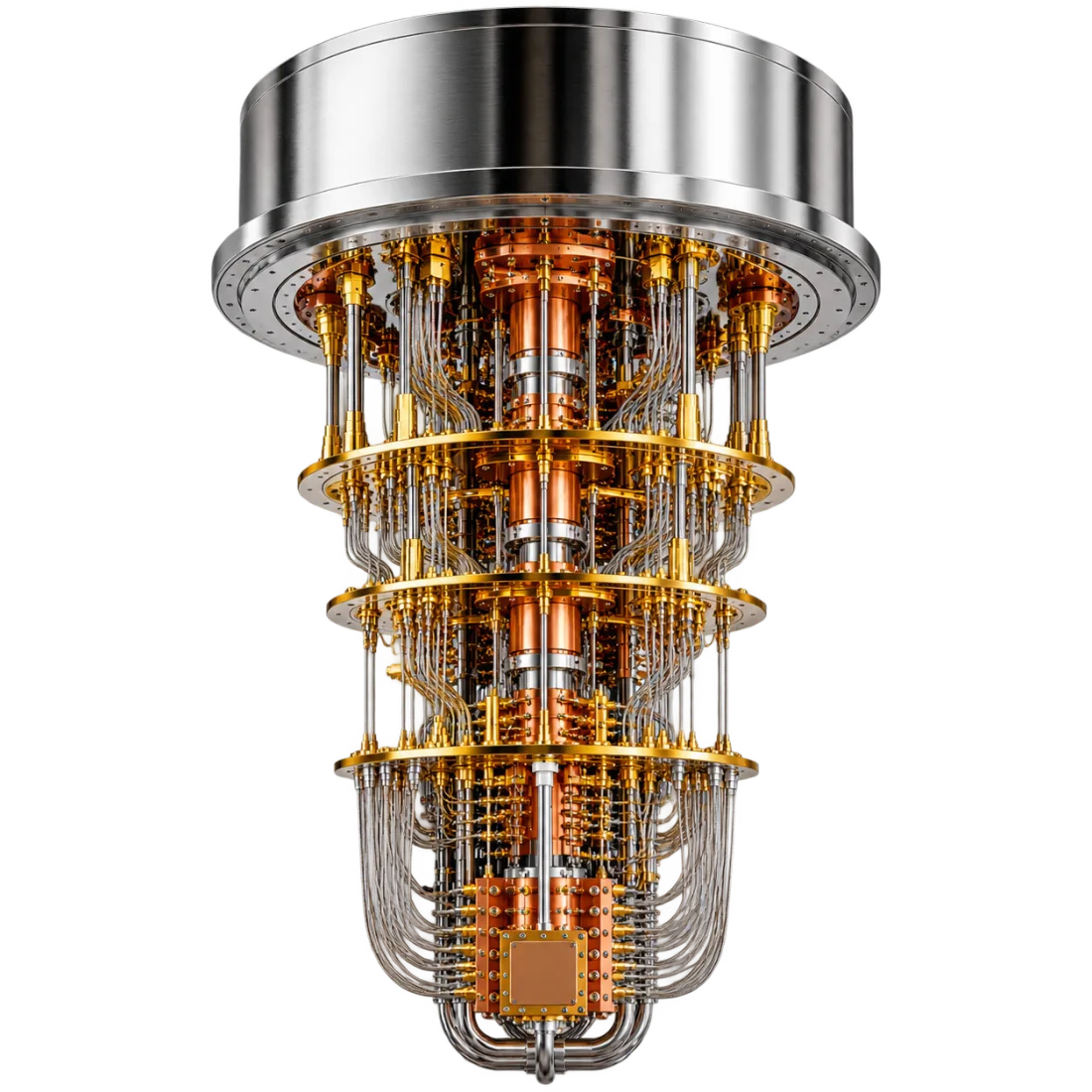
Explore the possibilities of quantum computing by building solutions to real-world problems.
Quantum Hack Day Kochi is a hands-on hackathon where students, developers, researchers, and technology enthusiasts come together to explore quantum computing, experiment with Qiskit, and build innovative solutions to practical challenges.
Quantum Hack Day Kochi is designed to make quantum computing more accessible through experimentation, collaboration, and hands-on problem-solving.
Participants will select a challenge, develop a solution, and demonstrate how quantum computing can contribute to addressing a real-world problem. Projects should combine clear problem formulation, meaningful technical implementation, and a practical demonstration.
What you can expect
Explore quantum computing through practical applications.
Build projects using Qiskit and relevant development tools.
Work on challenges in healthcare, mobility, energy, and sustainability.
Collaborate with fellow participants and exchange ideas.
Present your prototype and receive feedback.
Connect with the wider quantum technology community.
Who can participate?
Students and beginners
Developers and software engineers
AI/ML enthusiasts
Researchers and technology enthusiasts
Anyone interested in quantum computing applications
Prerequisites: Prior quantum computing experience is not required. Basic Python knowledge may be helpful, particularly for implementation-focused challenges.
Schedule
Timings to be confirmed
9:00–9:30 AMRegistration and Check-in
9:30–9:45 AMWelcome and Hack Day Briefing
9:45–10:00 AMChallenge Tracks and Problem Statement Reveal
10:00 AM–1:30 PMHackathon Build Sprint I
1:30–2:00 PMLunch and Networking
2:00–4:00 PMHackathon Build Sprint II
4:15–4:30 PMProject Submission and Demo Preparation
4:30–5:15 PMProject Showcase and Demos
5:15–5:30 PMJury Deliberation and Community Activity
5:30–6:00 PMAwards and Closing
Problem statements
Choose one challenge. Your solution should address the stated problem and include a meaningful quantum computing component.
Quantum Optimization for Emergency Vehicle Routing
The problem
Emergency response teams need to determine efficient routes for ambulances to reach multiple locations while accounting for distance, traffic conditions, and limited road availability.
In time-critical situations, inefficient routing can delay emergency response and affect outcomes.
Your challenge
Develop a quantum-assisted route optimization solution that determines an efficient route for an emergency vehicle visiting multiple locations.
Expected outcome: Build a model that minimizes total travel cost while producing a clear, interpretable route.
Inputs you can work with
A set of locations
Distances between locations
Optional traffic or travel-cost values
Starting location
Possible approaches
QAOA
QUBO formulations
Quantum optimization with classical preprocessing
Hybrid quantum-classical optimization
What to demonstrate
How the routing problem is represented mathematically
How your solution finds or evaluates routes
The role of the quantum component
Results and comparison with a simple classical baseline, where feasible
Quantum Machine Learning for Disease Classification
The problem
Medical datasets often contain multiple features that can help distinguish between healthy and diseased patients. Machine learning can use these features to support classification and pattern recognition.
Your challenge
Build a hybrid quantum-classical machine learning model that classifies patients using an appropriate dataset. The goal is to explore how quantum circuits can be incorporated into a machine learning pipeline, not to prove that quantum machine learning is inherently superior to classical machine learning.
Integration of the quantum model into the classification pipeline
Evaluation using appropriate metrics
Comparison with a classical baseline, where feasible
Important: Use publicly available or otherwise appropriately authorized data. Do not include personally identifiable patient information in your project or demonstration.
Challenge 03 · Quantum Optimization | Energy and Sustainability
Quantum Simulation for Energy Systems
The problem
Energy systems must balance generation costs, resource availability, capacity constraints, and electricity demand.
Finding a cost-effective allocation of available energy resources can help make energy planning more efficient.
Your challenge
Develop a simplified quantum-assisted model that allocates energy resources to meet demand while minimizing total generation cost.
Inputs you can work with
Multiple energy sources
Energy demand
Generation costs
Capacity constraints
Possible approaches
QUBO optimization
QAOA
Hybrid quantum-classical optimization
Small-scale quantum simulation
What to demonstrate
How the allocation problem is formulated
How capacity and demand constraints are handled
The resulting resource allocation
Total cost and feasibility of the solution
Comparison with a classical approach, where feasible
Challenge 04 · Quantum Optimization | Electric Mobility
Quantum Optimization for EV Charging Stations
The problem
As electric vehicle adoption increases, charging stations may experience periods of high demand. Poor scheduling can lead to long waiting times, inefficient use of charging infrastructure, and higher energy costs.
Your challenge
Develop a quantum optimization model that determines when and where electric vehicles should be charged while minimizing waiting time and energy costs.
Inputs you can work with
Electric vehicle locations
Battery levels
Charging station locations
Charging station capacity
Electricity costs at different times
Possible approaches
QUBO formulations
QAOA
Hybrid quantum-classical scheduling
Classical preprocessing combined with quantum optimization
What to demonstrate
How vehicles are assigned to charging stations
How charging schedules are generated
How capacity and charging requirements are handled
The resulting schedule and relevant performance metrics
Post-Quantum Cryptography for a Quantum-Safe Future
The problem
Many widely used cryptographic systems could become vulnerable to attacks from sufficiently powerful quantum computers. Organizations need to prepare for this threat by exploring cryptographic algorithms designed to protect sensitive data and secure digital communications in a post-quantum world.
Your challenge
Develop a prototype that demonstrates how an existing application or secure communication workflow can be upgraded using post-quantum cryptography (PQC). Explore how quantum-resistant algorithms can protect data while considering practical factors such as performance, key sizes, and compatibility.
Inputs you can work with
A sample application or secure communication workflow
Conventional cryptographic algorithms for comparison
Post-quantum cryptographic algorithms, such as ML-KEM or ML-DSA
Sample messages, files, or data to secure
Performance metrics, such as execution time and key or signature sizes
Possible approaches
Post-quantum key establishment using ML-KEM
Digital signatures using ML-DSA
Hybrid classical and post-quantum cryptography
Quantum-safe secure messaging or file protection
PQC performance benchmarking and migration tools
What to demonstrate
How the selected post-quantum cryptographic algorithm works within your application
How keys are established, messages are encrypted, or signatures are generated and verified
How the PQC implementation compares with a conventional cryptographic baseline
Performance measurements and practical trade-offs
How your solution could help prepare an application for the post-quantum era
Project requirements
Every submission must show a clear connection between the chosen problem and the proposed solution.
01Project information
Team name
Project name
Selected challenge
Names of team members
Team member roles, if applicable
02Problem definition
Explain the problem your project addresses.
What is the real-world problem?
Why does it matter?
Who is affected?
What are you trying to optimize, predict, classify, or simulate?
Recommended length: 150–300 words.
03Proposed solution
Describe your solution in a way that a reviewer can understand.
Your overall approach
Inputs, processing steps, and outputs
How the solution addresses the problem
Why you selected this approach
An architecture or workflow diagram is strongly recommended.
04Meaningful quantum component (mandatory)
Every project must contain a meaningful quantum computing component, such as QAOA, VQE (where appropriate), VQC, QSVM, quantum kernels, quantum neural networks, quantum simulation, quantum optimization, or other relevant Qiskit-supported approaches. Explain:
Which quantum technology or algorithm you used
Why you selected it
How the problem maps to a quantum formulation
What the circuit or algorithm does
What role the quantum component plays in the complete solution
Merely adding a Hadamard gate or an unrelated random quantum circuit does not qualify as meaningful quantum integration.
05Working implementation
Submit a reproducible implementation containing:
Source code
Python files and/or Jupyter notebooks
Installation and setup instructions
Required dependencies
Dataset or instructions for accessing it, where applicable
Instructions for running the project
Another person should be able to follow your README and run the project.
06Qiskit usage
Since this is a Qiskit Hack Day, use Qiskit wherever appropriate to your solution. Document:
Qiskit libraries used
Quantum circuits created
Quantum algorithms implemented
Simulator or backend used
If you use additional frameworks or tools, clearly identify their role.
Submission
Every team must submit its project before the official deadline announced by the organizers.
Required checklist
Team and project information
Selected problem statement
Problem definition and proposed solution
Explanation of the quantum component
Source code or Jupyter notebook
README with setup and execution instructions
Dependencies and dataset access instructions
Results and evaluation
Presentation slides or demo material
Recommended additions: Architecture diagram, screenshots, a short demo video, classical baseline comparison, and future improvements.
What makes a strong submission?
1.Address the chosen problem clearly.
2.Demonstrate a working minimum viable prototype.
3.Integrate quantum computing meaningfully.
4.Explain the technical implementation and design choices.
5.Present results and limitations honestly.
6.Be reproducible and easy to evaluate.
Teams are not expected to prove quantum advantage. A well-designed, honest, working prototype is more valuable than an ambitious idea without a functioning implementation.
Portal and deadline
Announced on the day
Repository
Public, or access-enabled as specified by the organizers
Demo format
Live demonstration during the showcase
Judging criteria
Phases and weightings to be confirmed
Phase 1: Idea and feasibility
Problem understanding and SDG relevance20%
Innovation and creativity25%
Feasibility within the hackathon timeline20%
Quantum component planning25%
Clarity of presentation10%
Phase 2: Prototype and implementation
MVP functionality and completion25%
Quantum component implementation25%
Technical implementation20%
Innovation and real-world impact15%
Demo and presentation15%
Rules and code of conduct
Rules pending organiser approval
01Original work
Participants should develop their own solutions during the hackathon and clearly acknowledge external code, datasets, libraries, and other resources.
02Relevant quantum integration
Every project must include a meaningful quantum computing component related to the selected challenge.
03Team participation
Both individual and team participation are permitted, subject to the final registration rules.
04Respectful collaboration
Treat participants, organizers, volunteers, and judges respectfully.
05Responsible data use
Use authorized datasets and do not expose confidential, personal, or sensitive information.
06Transparency
Clearly explain what has been implemented, what is simulated, what is incomplete, and what results have actually been obtained.
07Reproducibility
Provide sufficient documentation for judges to understand and, where possible, run your solution.
08Organizer instructions
Follow the event team's instructions regarding venue safety, equipment, access, and event operations.
Familiarize yourself with basic Python and quantum circuit concepts.
Set up your development environment in advance if possible.
Start with a small, testable objective.
Think about how you will evaluate your results.
Community and support
Stay connected with the organizers and fellow participants throughout the hackathon. Discord is where announcements, resources, team formation, submission guidance, and event-day support will happen.
The day closes with awards. Participants showcase their projects, explain their technical approach, and receive feedback from the evaluation panel. Every participant receives a certificate.
1 November 2026 · TinkerSpace, Kochi
Bring your curiosity, collaborate with others, and turn your ideas into working prototypes.